A full SaaS company built end to end - a browser-based pixel-art editor for game developers, wrapped in a complete brand, marketing site, billing platform, and conversion-designed funnel.
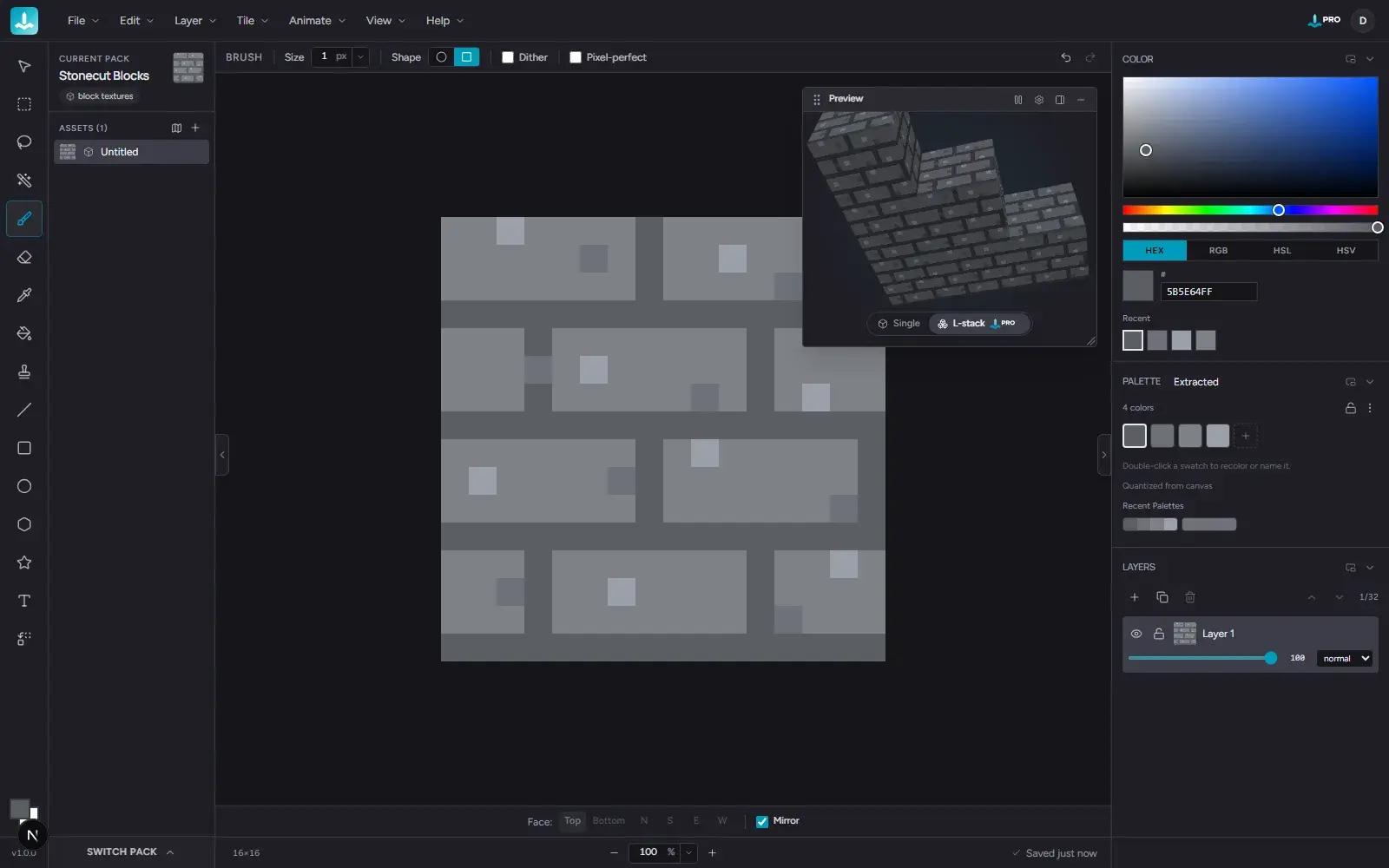
Axidus LLC is a software company I founded to build creative utilities for web designers, developers, and game developers. Its flagship product is Hexcalibur, a browser-based pixel-art editor purpose-built for voxel-game block textures - think Minecraft resource packs, Tiled tilemaps, and indie engines like Godot, Unity, Three.js, and Babylon.
This is the largest project in my portfolio and the one that goes deepest on UX. It is not a single website - it is an interconnected system: a marketing site with a unified account dashboard, a professional-grade creative tool with hundreds of interaction decisions, a freemium monetization model, transactional email, analytics, SEO, and a payments pipeline. Every screen, flow, and word of copy was designed, written, and shipped by me. It is live in production with real billing, currently in closed beta ahead of public launch.
Pixel artists who make textures for 3D voxel games have a fundamental problem: they paint on a flat 2D canvas, but their work lives on the faces of 3D blocks. Seams, tiling errors, and lighting issues only show up after a slow export-and-import round trip into the game engine.
Hexcalibur closes that loop. You paint in 2D and watch the texture update on a rotating 3D block in real time - across multiple block arrangements, so you catch tiling seams the moment you paint them. Around that core insight I built a full product strategy:
Hexcalibur is where the UX work goes deepest. A creative tool is thousands of small interaction decisions, and each one either builds or erodes the user's trust.
The editor uses a five-region layout: top menu bar, left tool rail, an asset switcher panel, a resizable 2D-canvas / 3D-preview split at center, and a right panel for color, palette, and layers. Every horizontal footer shares the same height so bottom edges align into a single visual baseline. The 3D preview is always visible and never collapsed - it is the product's reason to exist, so it is never more than a glance away. Right-panel sections can be shown, hidden, resized, or detached into floating windows that share one drag-and-resize system with a consistent grammar.
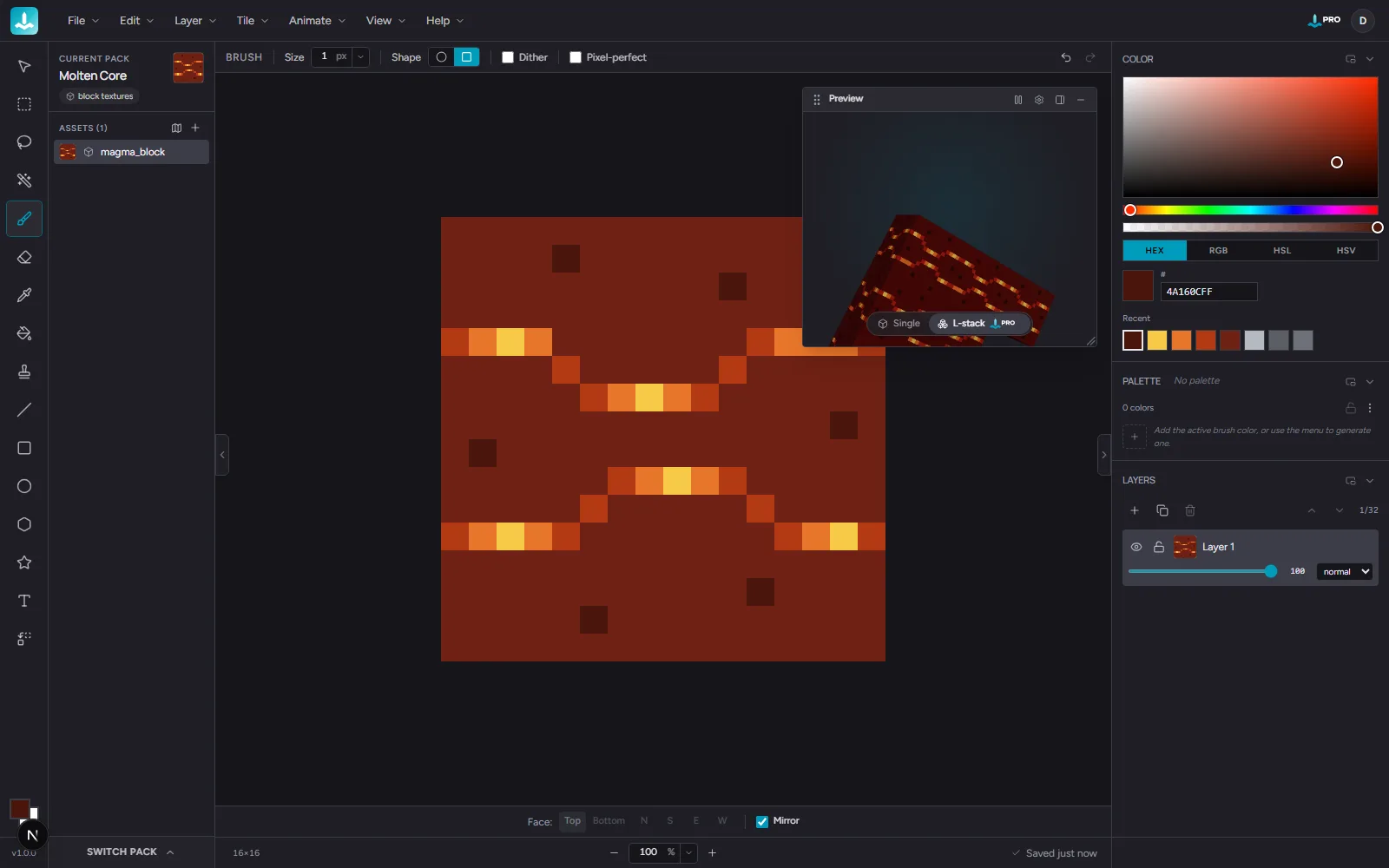
Sixteen tools, ordered into three clusters - transform, selection, paint - with no divider lines; the icon shapes themselves carry the grouping. Ordering is deliberate: the Tile Stamp sits directly after Fill so that in tilemap mode the enabled tool set reads as one unbroken run instead of scattering active tools among dimmed ones. Occasional tools park at the bottom, following conventions users already know from Photoshop - including keyboard shortcuts (B for brush, M for marquee, L for lasso).
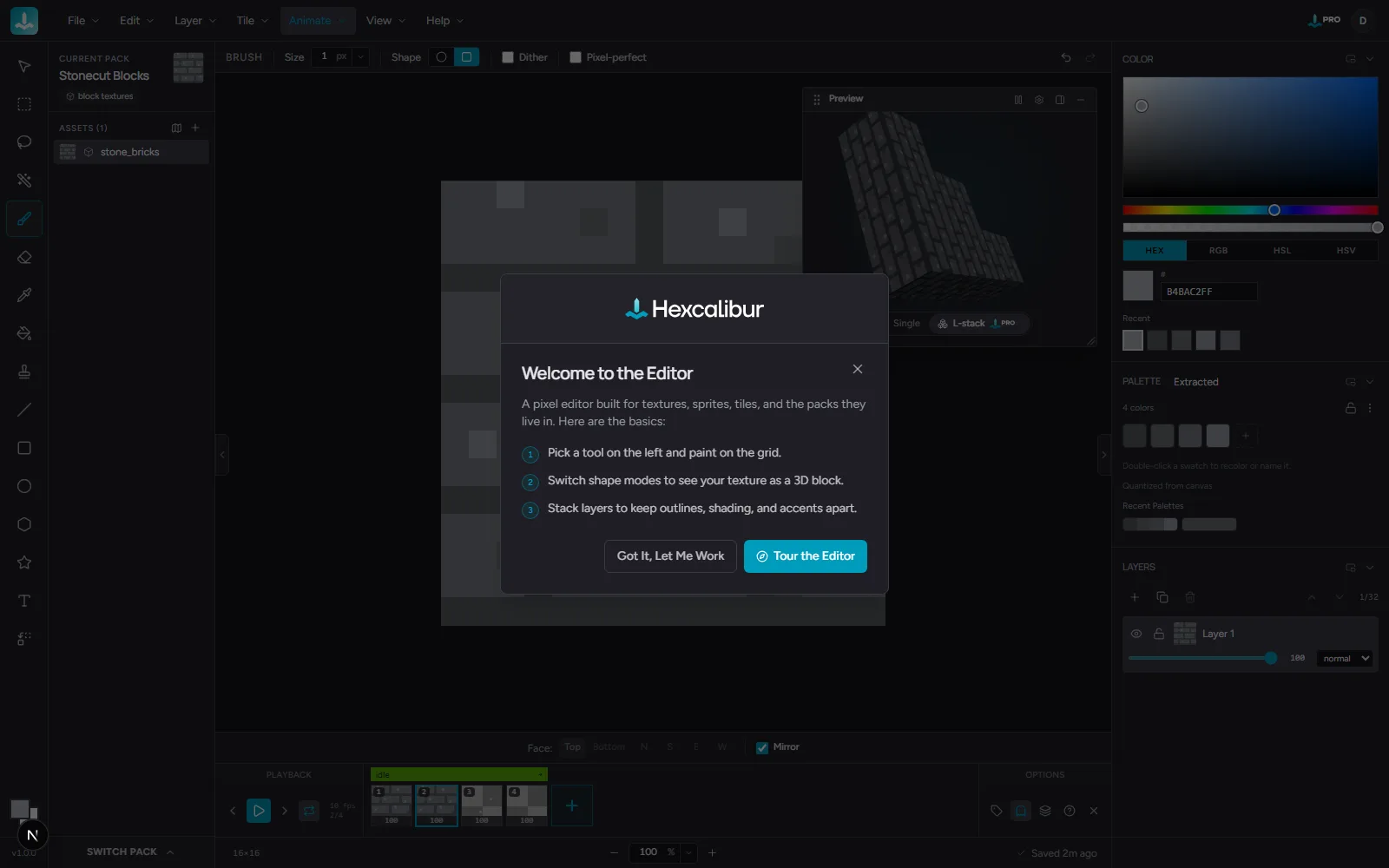
New users get a guided, per-surface tour system - 4 steps in the pack browser and a 21-step editor tour that walks the tool rail, color and palette systems, layers, the 3D preview, importing, and a continuous deep-dive through the export dialog for each game engine. Shorter tours cover the animation timeline and tilemap mode, each triggering the first time the user reaches that surface and replayable from the Help menu. A firm rule I held: tour demo content is always synthetic and visual-only - a tour must never mutate the user's real work.
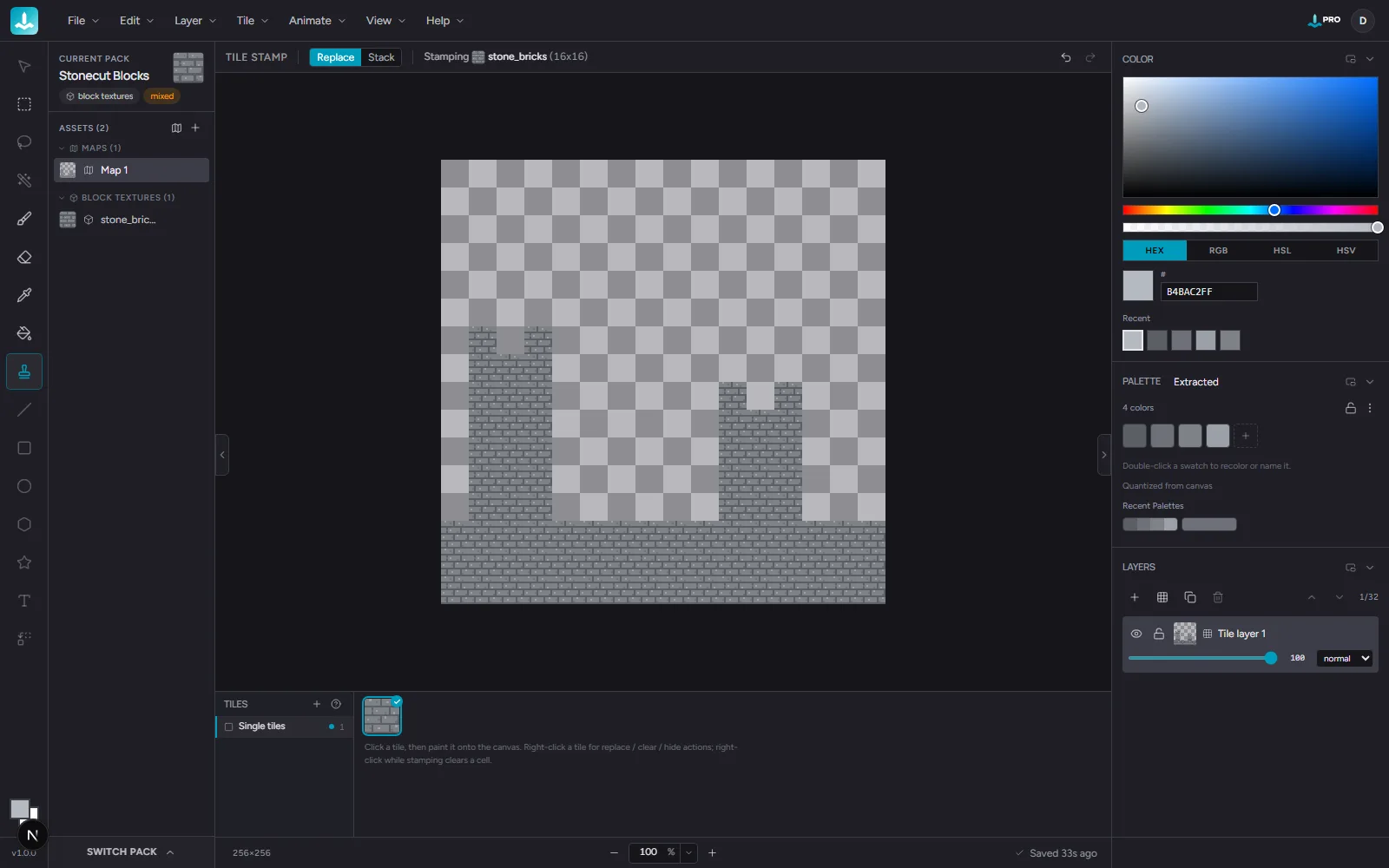
Complex features stay out of the way until relevant. The animation timeline is completely hidden for single-frame assets - no vertical tax on users who just want to paint a block. Tilemap tooling lives in a tile shelf that only appears for tile-based packs. Mirror mode (paint one face, all faces update) defaults on for first-timers because most block textures are uniform - and turning it back on after faces have diverged is guarded by a confirmation dialog, and undoable.
The free tier is a real product, not a demo: the full editor, one pack of eight assets, unlimited local saves, PNG and GIF export. Pro gates appear softly - a small lock or PRO badge only when a gated control is actually touched, never as a nag. The upgrade modal explains the specific capability that triggered it, and pre-selects the lifetime plan as an anti-subscription anchor. Downgrading degrades gracefully: an ex-Pro user's cloud packs stay readable and deletable - you can stop paying without losing your work. Entitlements are enforced server-side, with client-side clamps so gated preferences can never leak through a stale local state.
The other half of the UX story is the path from stranger to paying customer.
The Hexcalibur landing page is a bespoke, conversion-focused build - video-led, structured on AIDA with the strongest differentiator first so the core value lands within five seconds. Eleven sections run from the hero ("Paint in 2D. See it in 3D.") through problem statement, three differentiator deep-dives, a tabbed feature showcase, audience self-select, trust signals, pricing, and a zero-JavaScript FAQ to a final CTA band.

The conversion mechanics:
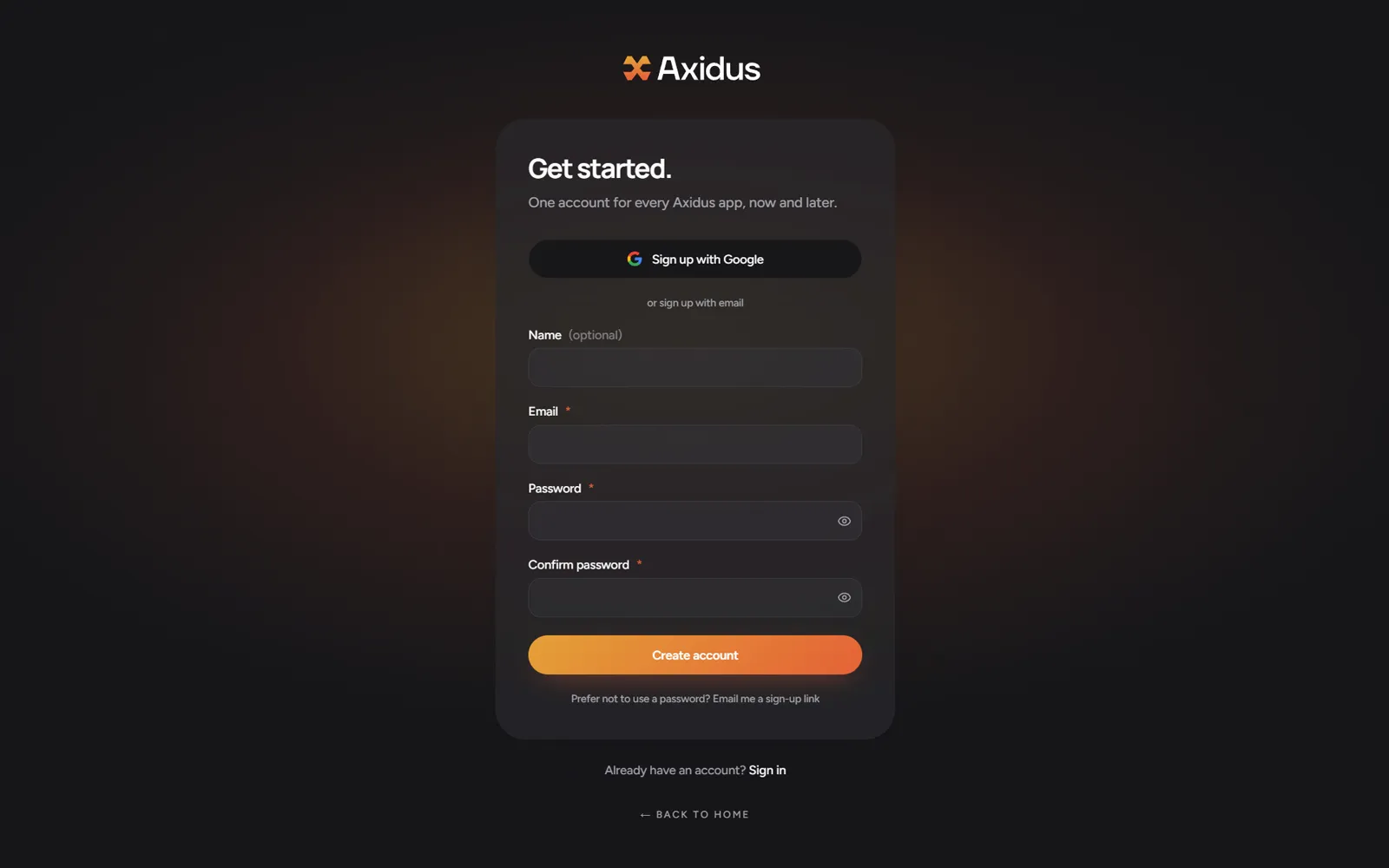
Sign-up offers exactly three options - password, Google, or magic link - and same-email identities merge into one account, with cross-method nudges for the classic "which method did I use?" moment: a failed password attempt on a passwordless account points you to the right method instead of a dead-end error. Auth emails are six custom-branded HTML templates sent from a dedicated subdomain.
The account area covers the full lifecycle: TOTP two-factor with single-use recovery codes, step-up re-authentication before destructive actions, active-session management, GDPR data export, email preferences, avatar upload with client-side crop, and a getting-started checklist on the dashboard.
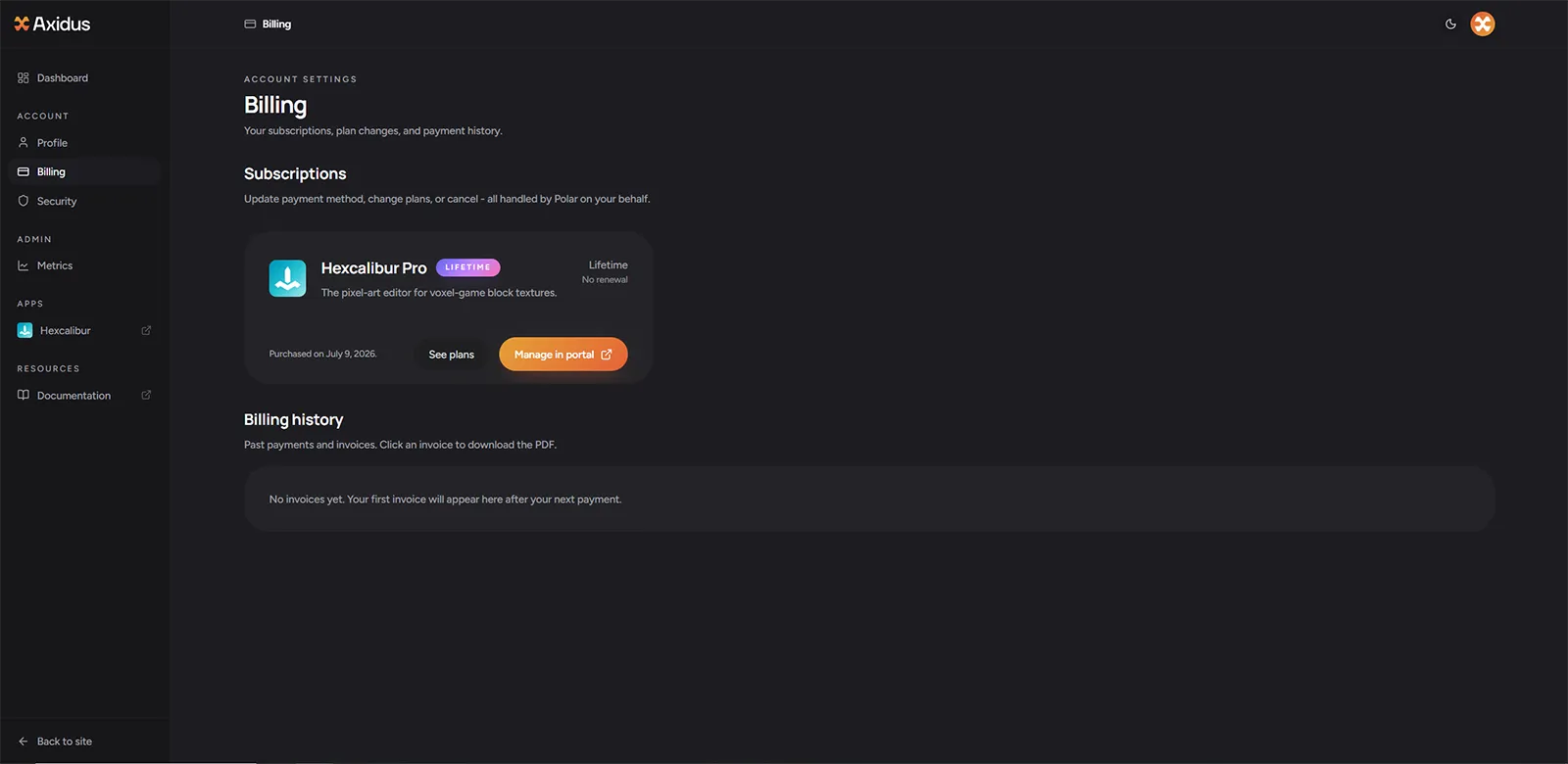
Pricing offers three cadences - monthly, annual (the hero plan), and lifetime, styled in its own iridescent gradient so it reads as premium. Checkout is Polar-hosted and resumes intelligently: a logged-out buyer signs in and lands back in the exact checkout they started. Buying lifetime while on a subscription auto-cancels the subscription at period end - no double billing, no support ticket. Because payment confirmation arrives asynchronously via webhook, I designed polling states so the UI shows "activating your Pro plan" instead of a confusing stale page.
Because I built this to run as a real business, the marketing layer is as engineered as the product:
Hexcalibur began as HYBRUSH, a v1 prototype aimed at a single game platform. When that platform shut down, I rebranded, repositioned around the engines people actually ship to, and rebuilt it inside the Axidus platform. Major post-launch rounds shipped an animation timeline with onion skinning and tagged loops, a full tilemap mode with autotiling and terrain generation, custom canvas sizes up to 512x512, a lossless native file format, and the unified export dialog - each round including its own onboarding tour, documentation, and landing-page updates so product, education, and marketing never drift apart.
The pricing model also evolved through deliberate iteration: a trial became a permanent free tier, pack count became the conversion lever, annual became the hero plan, and a lifetime tier with a Founding Member badge was added as the anti-subscription option.

